
Exterior Lighting Built Into the Structure Itself
Permanent Holiday Lighting in Grove City for homeowners and property owners who want year-round lighting capability without seasonal installation and removal
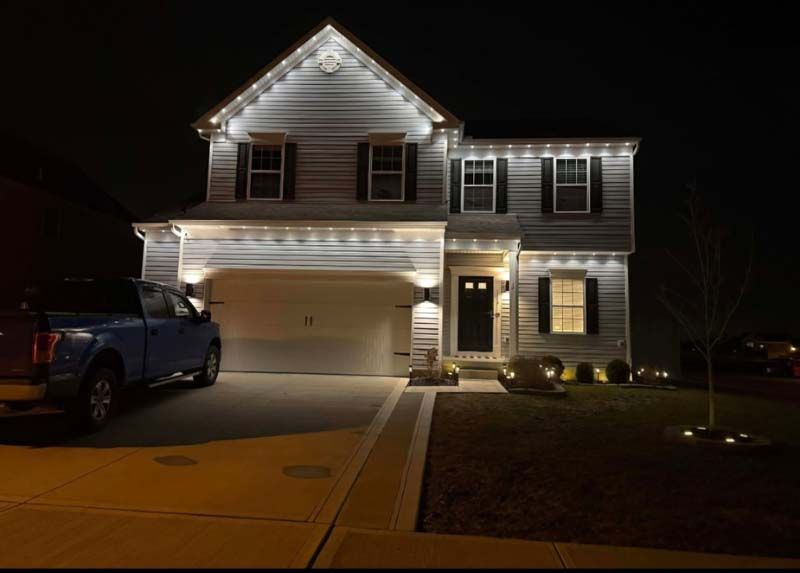
What changes after permanent holiday lighting is installed is straightforward: the exterior of the home or building gains a lighting system that can be activated, adjusted, and reprogrammed from a phone, and the annual cycle of putting up and taking down temporary strands stops entirely. Wilson Landscaping installs permanent holiday lighting systems in Grove City that are integrated into the roofline and eave structure rather than clipped over it, producing a clean exterior profile when the system is off and a fully customizable display when it's on. Homeowners who have dealt with annual installation for years notice the difference immediately in how the exterior looks at rest—no visible hardware, no clip marks, no seasonal staging area in the garage.
The installation process involves mounting fixed-channel track along rooflines, eaves, and other exterior features that are identified during the initial design assessment. Individual lighting nodes are seated into the channel and wired back to a central controller that manages color, brightness, pattern, and schedule. Because the system is permanent, the wiring runs are planned to be concealed within or behind exterior trim wherever the structure allows—this is the step that separates a permanent system that looks integrated from one that looks like temporary lighting bolted in place.
Request a property assessment to review your exterior's layout and identify the best routing plan for a permanent system installation.
Why Permanent Systems Perform Differently Over Time
Permanent holiday lighting systems use individually addressable LED nodes rather than strand-based lighting, which means each point of light can be independently controlled for color and intensity. This is what makes the color-changing and pattern effects possible—the controller communicates with each node separately rather than running a single signal across a whole strand. The practical result is that the same physical installation produces a warm white roofline for Thanksgiving, a full multicolor display for Christmas, and a red-and-green or red-white-and-blue layout for other occasions, all without touching a single fixture.
After installation, the exterior trim line reads cleanly in daylight because the channel track is sized to sit flush against the fascia rather than projecting outward. Grove City properties with traditional two-story and split-level construction—common in neighborhoods developed from the late 1970s through the 1990s—typically have consistent fascia widths that accommodate standard channel profiles well, though homes with decorative trim profiles or non-standard eave overhangs require a design adjustment at the layout stage. Wilson Landscaping evaluates those conditions during the assessment before hardware is ordered.
Smart control options vary by system but typically include mobile app scheduling, preset scene libraries, and integration with home automation platforms. Scheduling means the system turns on and off automatically at defined times, so the exterior is lit during the hours that matter without requiring manual activation each day.
Common Questions About This Service
Property owners considering permanent holiday lighting most often ask about how the system is controlled, how it looks when it's not active, and what the installation involves relative to the home's existing exterior.
How does the smart control system actually work?
A dedicated app connects to the system's controller and allows you to set schedules, choose colors, activate preset patterns, or manually adjust brightness—changes take effect immediately without requiring physical access to any fixture.
What does the system look like during the day when it's turned off?
The channel track sits along the roofline or eave in a low-profile position, and because the nodes are seated inside the channel rather than clipped over fascia or gutters, the exterior reads cleanly without visible hardware accumulation at the roofline edge.
How are wiring runs handled during installation?
Wiring is routed through or behind exterior trim wherever the structure allows, with surface-run cable used only where concealment isn't possible—the routing plan is established during the design assessment before any installation begins.
Why do homes with non-standard trim profiles require a different layout approach?
Channel track is sized to standard fascia widths, and decorative trim profiles or deep eave overhangs can change the mounting geometry enough that standard hardware doesn't sit flush—catching that during design prevents visible gaps or misalignment in the finished installation.
What maintenance does a permanent lighting system typically require?
Individually addressable LED nodes are rated for extended outdoor use, but individual nodes that fail can be replaced without disturbing the rest of the installation—the channel system is designed so each node seats and releases independently.
Wilson Landscaping also installs permanent holiday lighting in Hilliard, Columbus, Galloway, and Groveport. Homeowners ready to move away from annual installation cycles can connect with Wilson Landscaping to schedule an exterior assessment and discuss system options based on their property's specific roofline and trim layout.